

Mouse Droppings: What They Look Like and What to Do
Finding little black droppings in the pantry, a kitchen drawer or along the skirting boards is usually the first sign of mice. Mice are active at night and good at hiding, so the droppings often show up long before you see a mouse. This guide shows you how to tell mouse droppings from rat and possum droppings, how to clean them up safely, and what they tell you about where the mice are getting in.
What do mouse droppings look like?
- Size: small, about 3 to 7 mm long, roughly the size of a grain of rice.
- Shape: thin and rod-shaped, with pointed ends.
- Colour: dark brown to black when fresh.
- Amount: lots of them. A single mouse can leave 50 or more droppings a day, scattered rather than in neat piles.
You’ll usually find them in kitchen cupboards and drawers, in the pantry, behind the fridge and oven, under the sink, along skirting boards, and on top of shelves, because mice are good climbers.
Mouse, rat or possum droppings?
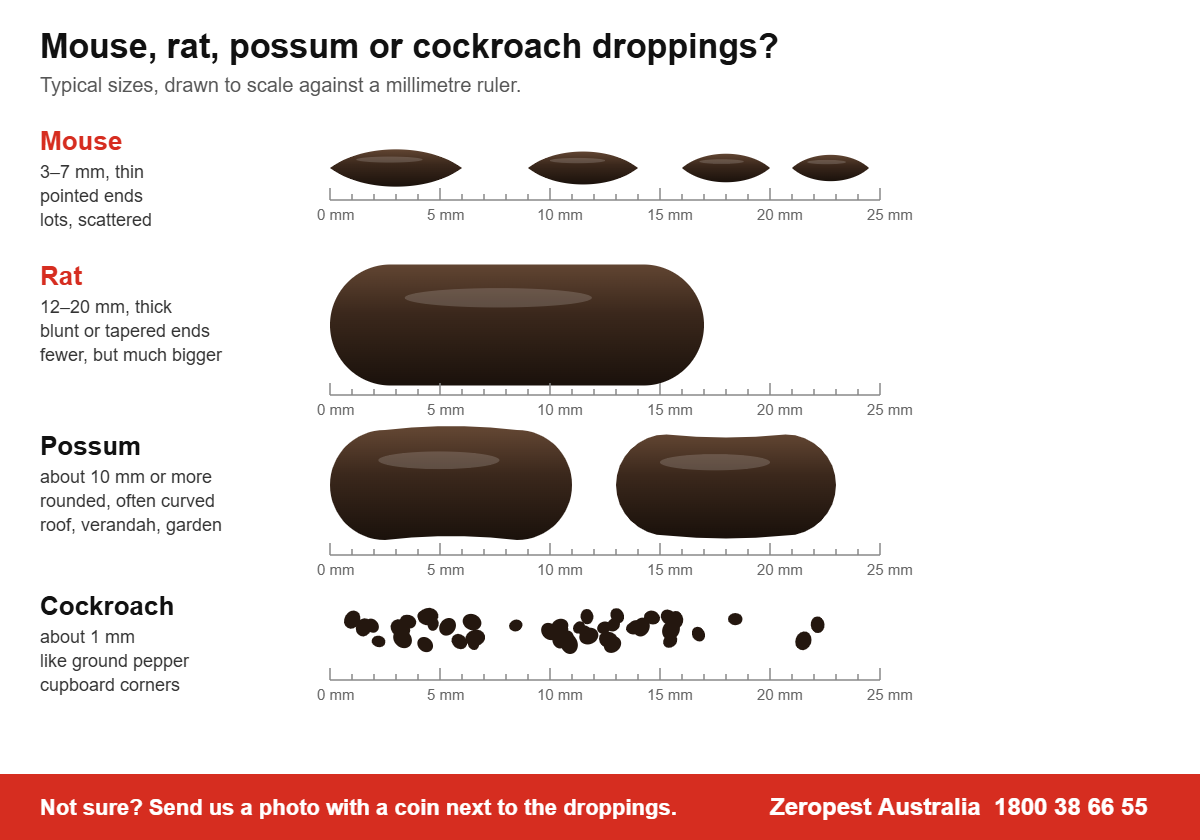
Typical dropping sizes, drawn to scale. Compare yours against a ruler or coin.
- Mouse: 3 to 7 mm, thin, pointed ends, scattered in large numbers.
- Rat: much bigger and thicker, often 12 mm or longer, about the size of an olive pit. Fewer droppings, but each one is several times larger.
- Possum: larger pellets, often around 10 mm or more, usually found in the roof void, on the verandah or around the garden, often with a strong urine smell and stains on the ceiling.
- Cockroach: tiny dark specks, like ground pepper, in cupboard corners and hinges. Easily mistaken for very small mouse droppings.
Not sure what you’ve got? Take a photo with a coin or a ruler next to the droppings and send it to us. We’ll tell you what it is.
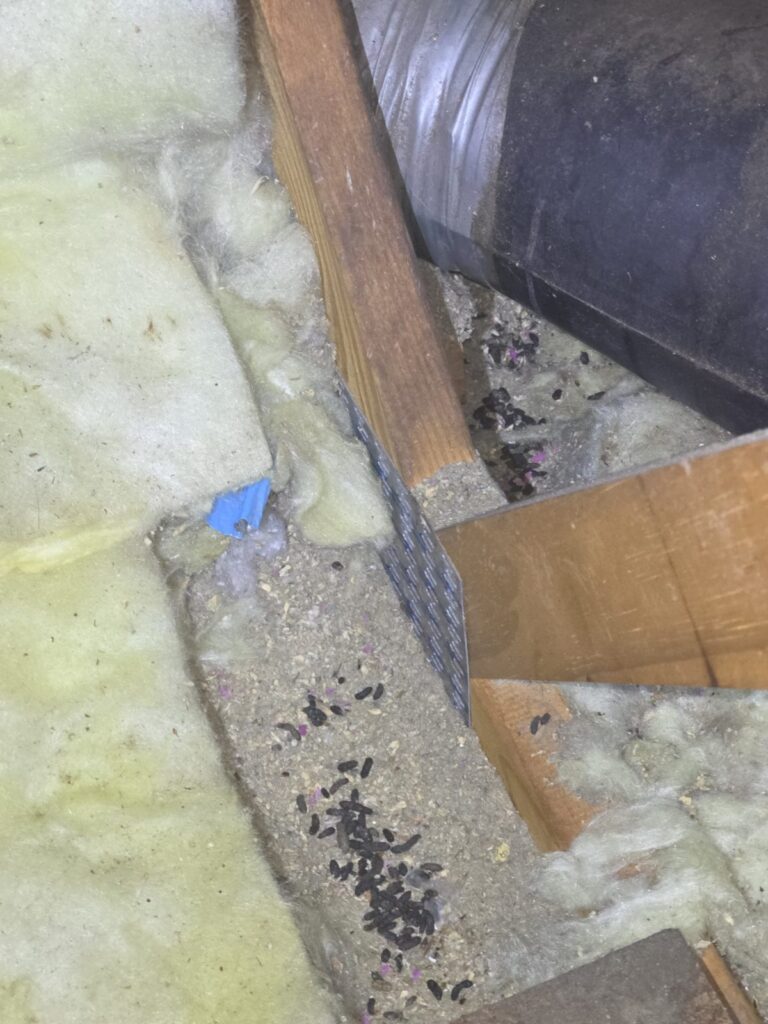
Real rat droppings in a Melbourne roof void: much bigger and thicker than mouse droppings, and often in piles along the timbers where rats run.
Think it might be rats? See real photos of rat droppings, rub marks and roof entry points from our Melbourne jobs.
What the droppings tell you
- Fresh or old: fresh droppings are dark, soft and slightly shiny. Old droppings are dry, hard, dull or greyish, and crumble when pressed. Fresh droppings mean mice are active now.
- Where they are: droppings collect along the routes mice use, so a line of them along a wall or behind an appliance shows you a runway. Follow it back towards gaps around pipes, cupboards and walls.
- Different sizes: a mix of small and larger droppings usually means young mice, so they’re breeding in or near the house.
Droppings under the sink tell you where mice are active, not necessarily where they got in from outside. See how mice get into Melbourne homes for the 8 entry points to check.
Are mouse droppings dangerous?
Mice and rats can carry diseases such as salmonellosis, campylobacteriosis and leptospirosis, which can infect both people and pets. Health authorities say these can spread through contact with rodents, breathing in dust contaminated with their urine or droppings, and eating food or drinking water they’ve contaminated. Rodents also chew through electrical wiring, which can start fires. Read the WA Health advisory on mice for more.
So droppings aren’t just unpleasant. Any food they’ve touched should be thrown out, and they should be cleaned up carefully.
How to clean up mouse droppings safely
- Air the room. Open windows and doors for a while before you start.
- Protect yourself. Wear disposable gloves, closed shoes and a face mask, and cover any cuts with a waterproof dressing.
- Wet them first. Spray the droppings and the area around them with household disinfectant or a diluted bleach solution (follow the label), and leave it to soak for a few minutes.
- Don’t dry-sweep or vacuum. Sweeping or vacuuming dry droppings can stir up contaminated dust. Wipe them up with paper towel instead.
- Bag and bin. Put the paper towel and droppings in a sealed plastic bag in your general rubbish.
- Disinfect and mop. Clean the shelves, benches and floor with disinfectant, and throw out any food in packaging the mice have chewed or soiled.
- Wash up. Wash affected bedding and clothes in hot water, take your gloves off, wash your hands with soap, and change your clothes.
Ideally, the clean-up should be done by someone who is well and doesn’t have a weakened immune system. If you’re pregnant, ask someone else to do it.
Droppings in the roof? Don’t crawl around the roof void to clean up. It’s dusty, and there’s a risk of falling through the ceiling. We inspect the roof void as part of every mice treatment.
Cleaning up won’t stop the mice
Droppings are a sign, not the problem. If mice are getting in, new droppings will keep appearing until the entry points are closed. Supermarket baits and traps may catch a few, but if the holes stay open, new mice move in to replace them. That’s why so many people find mice coming back after a cheap treatment.
How we get rid of mice for good
Our mice treatment is built around finding and closing the way in:
- Exterminate: professional-grade rodenticide placed inside wall cavities and in secured roof void bait stations, away from people, children and pets.
- Track: we follow the droppings, rub marks and runways to map where the mice are moving and nesting.
- Block inside, on the same visit: every internal entry point we find is blocked, so mice can’t keep moving between the walls and your cupboards.
- Document outside: every external entry point is photographed and documented, ready to be blocked once there’s no further activity, or at the latest 14 days after the initial treatment.
Internal blocking is included in the treatment. You get our 5-year guarantee once you block the external entry points we identify and photograph for you, or a Lifetime guarantee when Zeropest completes the external proofing (quoted separately). If you choose not to block them, a 3-month guarantee applies. All subject to our guarantee terms.
Mouse droppings FAQs
How can I tell if mouse droppings are fresh?
Fresh droppings are dark, soft and slightly shiny. Old ones are dry, hard and dull or greyish, and crumble when pressed. If you clean an area and new droppings appear in the next day or two, the mice are still active.
Can I vacuum mouse droppings?
Not straight away. Vacuuming or dry-sweeping can stir up contaminated dust. Spray the droppings with disinfectant first, let it soak, then wipe them up with paper towel and bin them in a sealed bag.
Are mouse droppings dangerous to my dog or cat?
The same diseases that affect people can affect pets, so keep pets away from droppings and clean them up promptly. Our baits go inside wall cavities and secured bait stations, out of reach of pets.
Do a few droppings mean I have an infestation?
Even a few droppings mean mice have been inside. Because mice breed quickly, it’s best to act early, before a few become many. Lots of droppings, or droppings of different sizes, usually means a bigger, breeding population.
Are they mouse or rat droppings?
Mouse droppings are about 3 to 7 mm with pointed ends. Rat droppings are much bigger and thicker, often 12 mm or longer. If you’re unsure, send us a photo with a coin next to them.
Found droppings in the kitchen or roof? Call 1800 38 66 55 or request a free quote. We service all of Greater Melbourne, 7 days. More rodent help in our pest guides.


